


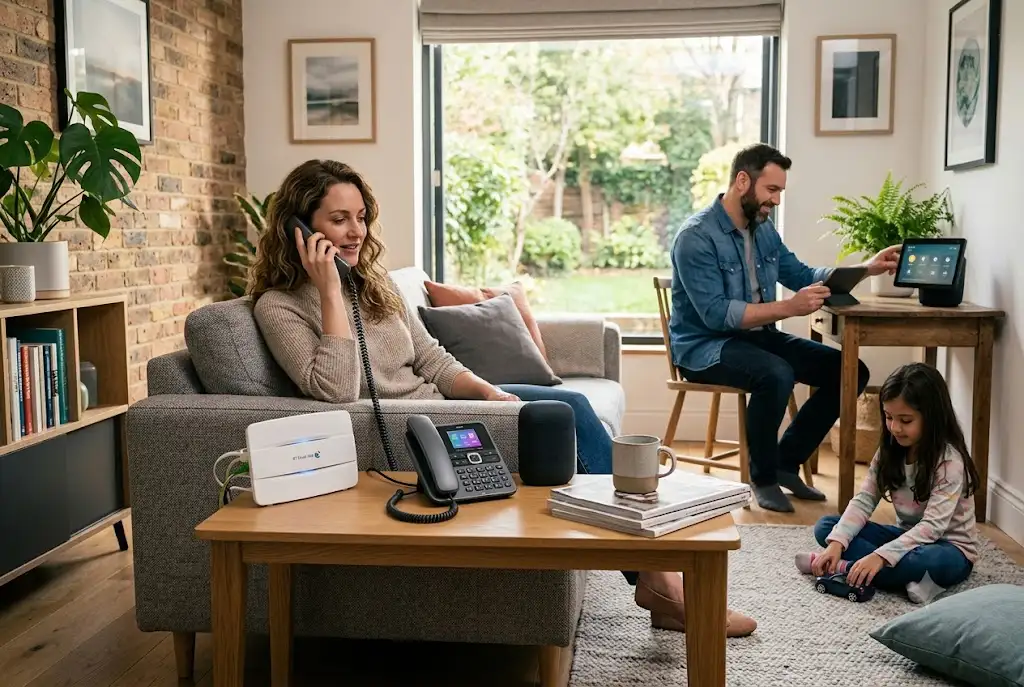
For decades, homephones were the primary way families communicated with friends, businesses, and emergency services. Before smartphones became commonplace, nearly every household in the UK relied on a home telephone line for daily communication.
Today, mobile technology dominates personal communication. However, homephones continue to play an important role for many households, businesses, and organisations. Modern home telephone services have evolved significantly, offering digital capabilities that differ greatly from traditional landline systems.
As the UK’s telecommunications infrastructure continues to modernise, understanding the future of home telephone services can help consumers make informed decisions about their communication needs.
The Evolution of Home Telephone Services
Traditional homephones operated through the Public Switched Telephone Network (PSTN), a system that connected calls through physical copper telephone lines.
For many years, this infrastructure provided reliable voice communication throughout the country. However, advances in digital technology have transformed how voice services are delivered.
Modern home telephone services increasingly use internet-based technologies rather than legacy analogue systems.
This transition is part of a broader shift toward digital communications and connected infrastructure.
Why Some Households Still Use Homephones
Although mobile devices are now widespread, many households continue to maintain home telephone services for practical reasons.
Common benefits include:
- Reliable contact number for the household
- Easy communication for elderly family members
- Improved call quality in some locations
- Support for certain alarm and monitoring systems
- Backup communication option
- Bundled broadband and phone packages
For some users, homephones remain an important part of daily life despite changing communication habits.
Digital Voice and Internet-Based Calling
The future of home telephony is increasingly digital. Many providers now offer voice services through broadband connections rather than traditional telephone networks.
These systems are often referred to as:
- Digital Voice
- Voice over Internet Protocol (VoIP)
- Internet Calling
- IP Telephony
Rather than transmitting calls through legacy telephone exchanges, digital voice services use internet connectivity to facilitate communication.
This approach offers greater flexibility and supports modern communication features.
How Computing Technology Supports Modern Communications
Modern telephone systems rely heavily on the same technologies that support internet communication, cloud services, and digital applications.
Many of the systems used in computing technology to connect devices and networks also support voice communication services.
These technologies include:
- Networking infrastructure
- Internet protocols
- Cloud-based communication platforms
- Data routing systems
- Security technologies
- Wireless connectivity solutions
The convergence of telecommunications and computing continues to reshape how people communicate at home and work.
The Difference Between Homephones and Mobile Phones
While both technologies provide voice communication, they serve different purposes.
Homephones
- Fixed location communication
- Often included with broadband packages
- Shared household access
- Typically stable indoor call quality
Mobile Phones
- Portable communication
- Internet access on the move
- Messaging and applications
- Location-independent connectivity
Many households now use a combination of both depending on their specific requirements.
Home Telefono and International Communication Trends
The concept of the home telefono remains important in many countries, although technologies and consumer preferences continue to evolve.
Across international markets, service providers are replacing older analogue infrastructure with modern digital communication platforms.
This shift reflects broader technological changes affecting homes, businesses, and public services worldwide.
Smart Homes and Connected Communications
Modern communication systems are increasingly integrated into smart home ecosystems.
Connected technologies allow homeowners to manage devices, monitor security systems, and communicate through multiple platforms.
Examples include:
- Smart speakers
- Video doorbells
- Home security systems
- Voice assistants
- Remote monitoring solutions
- Connected communication hubs
As smart home adoption grows, communication technologies continue to become more integrated with everyday digital experiences.
The Role of Data Networks in Voice Services
Modern voice communication increasingly depends on efficient data transmission.
Behind every digital phone call are networking systems that manage routing, processing, and delivery of voice information.
Many of these processes rely on principles similar to those found in algorithms and data structures, where information must be organised, routed, and delivered efficiently.
These technical foundations help ensure reliable communication experiences for users.
Will Homephones Disappear Completely?
Despite declining usage compared to previous decades, homephones are unlikely to disappear entirely in the near future.
Several factors continue to support their relevance:
- Demographic preferences
- Business requirements
- Emergency communication needs
- Digital voice service adoption
- Broadband package integration
What is changing is the underlying technology used to deliver these services.
Traditional analogue infrastructure is gradually being replaced by digital alternatives that offer improved flexibility and functionality.
Future Communication Technologies
The communications sector continues to innovate rapidly.
Emerging developments include:
- Cloud communication platforms
- AI-assisted voice services
- Enhanced VoIP systems
- Integrated smart home communications
- Advanced broadband infrastructure
- Unified communication solutions
These technologies will likely influence how households communicate in the years ahead.
Conclusion
Homephones remain a relevant communication tool for many UK households, even as mobile devices dominate modern communication. The transition from analogue systems to digital voice technologies is reshaping the telecommunications landscape while preserving the core benefits that home telephone services provide.
As connectivity continues to improve and communication technologies evolve, consumers can expect more flexible, integrated, and feature-rich home communication solutions.
For information about the UK’s telecommunications transition and digital voice services, guidance from Ofcom provides valuable updates and consumer information.
